Why uncertainty deserves its own section
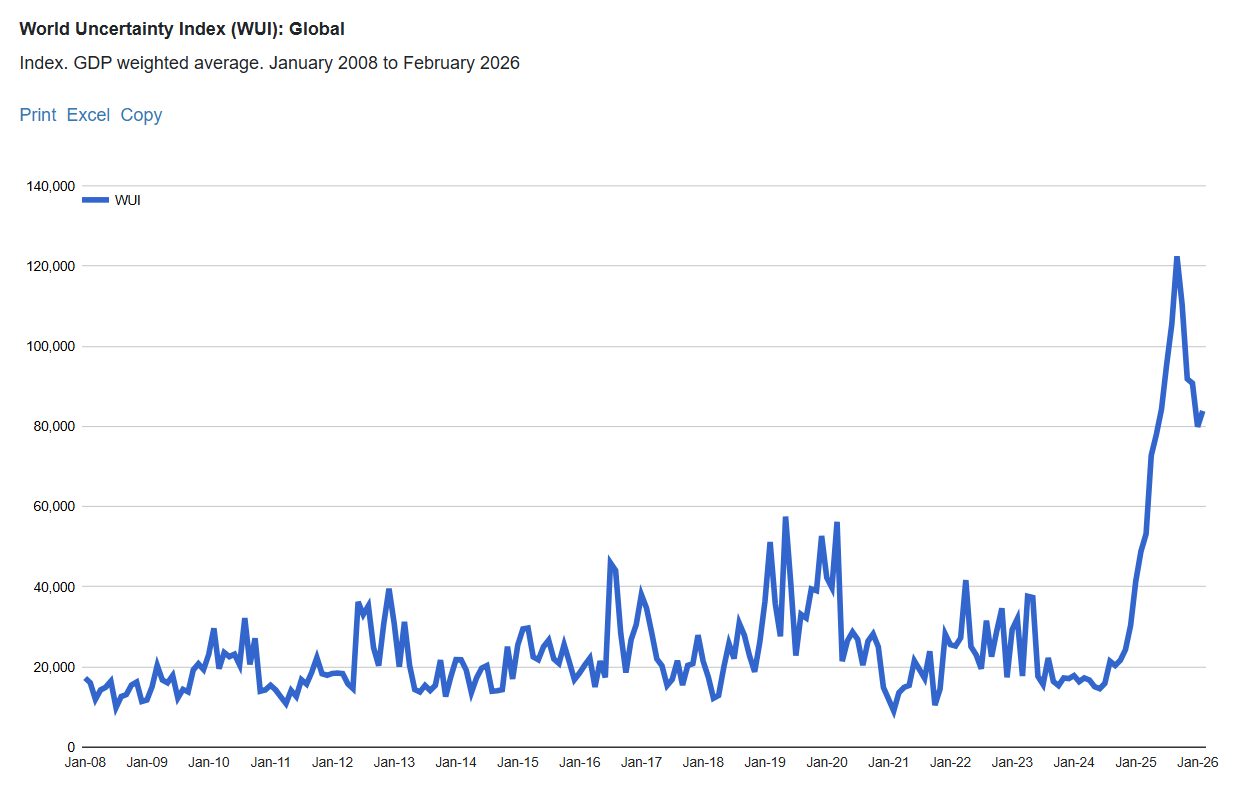
One could spend time justifying the relevance of this topic — but sometimes a single chart is enough. The World Uncertainty Index [1] is now reaching levels not seen in the past half-century.
Uncertainty is not a crisis to be endured. It is a new coordinate system. And as it becomes the norm, we need tools that make it livable.
Premises
On average, a person has more than 6,200 thoughts per day — likely far more.
Up to 85% of what we worry about never happens.
And among the few things that do happen, 79% of people admit they handled them better than expected and gained something valuable from the experience.
This is not a reason to dismiss anxiety. It is a reason to be more deliberate about where attention goes. Time, energy, and attention are limited resources. In conditions of uncertainty, they cannot be spent carelessly.
Two sides of the same problem
When the ground feels unstable, two questions arise:
How do I feel? — a question of mental state.
How do I act? — not in theory, but here and now.
If the second question seems self-evident, the first deserves to be reconsidered again. In this section, we invite you to draw on carefully selected methods, tools, and strategies — stripped of anything superfluous. The primary criterion is practical applicability.
What helps
Science and practice have already done much of the work. The task is to choose what fits:
A shift in coordinates — from rigid goals to values.
Regulation of mental state — primarily evidence-based practices from cognitive behavioral therapy, and beyond.
Game theory (in its applied sense) — how to make decisions with incomplete information.
Work with cognitive biases — letting go of your 'rose-colored glasses'.
And dozens more. The range is wide — and that is a good thing. Everyone can find a configuration that allows them to breathe more freely.
Why values?
The word values often feels abstract, even detached from everyday life. You might say: "What values, when my task list already exceeds what is physically possible in a day?" And yet, this question cannot be avoided.
Goals tend to define who you will become.
Values describe who you already are.
Values are what remain stable when forecasts disappear. They do not replace goals — they ground them. A goal rooted in values stops being an item on a list. It becomes part of your identity.
And once values are clear, the path toward a goal carries not only an outcome, but meaning.
A note on "Game Theory"
Do not be put off by the word theory. We take from it only what can be used — practically, immediately.
What matters most here is decision-making under conditions of incomplete, ambiguous, or entirely absent information. What better describes uncertainty than the absence of reliable forecasts combined with the need to act now?
You do not need to read textbooks. The system adapts these tools to your specific situation — offering not a lecture, but a practical suggestion.
Many people today face a choice: compromise privacy, or give up the advantages of AI. Our task is to find a balance — so that this choice is no longer binary.
What we offer
Two formats — from universal to highly personalized:
Access to specialized system prompts.
Built on research, books, and applied practices. Only working tools, curated by humans — without unnecessary theory.
Personalized working files.
If you already have materials — beliefs, sources, preferred approaches — we assemble them into a configuration tailored to you.
How to use it
As a standalone tool — for example, to validate your own decisions.
Or as part of your personal InCouncil ecosystem — as an additional advisor among your agents.
Need an outside perspective? A second opinion?
Try looking at yourself through the eyes of your better self. Or from a future version of you, observing the present. And when you meet that look — is this truly the person you want to be?
[1] The World Uncertainty Index is computed by counting the percentage of the word "uncertain" (and its variants) in Economist Intelligence Unit country reports. worlduncertaintyindex.com